Mizan — Final Architecture
Status: design for review (pre-implementation) Date: 2026-08-09 Author: mizan-architect Supersedes and REPLACES docs/architecture.md (draft, 2026-08-07): its unique, still-accurate content is folded in here and the standalone draft file has been removed (2026-08-09). Companion: design/collaboration-design.md (contribution layer), design/implementation-plan.md (phasing + acceptance criteria) Ground truth (do not re-derive): docs/research.md.
This document confirms what the retired 2026-08-07 draft got right, folds in the collaboration layer, and records the decisions the draft left open. Where a decision depends on a spike still running, it is marked pending spike verdict and the dependent detail is deferred, not guessed.
1. Problem & Goals
Section titled “1. Problem & Goals”Mizan is a Go tool over the Vertex AI Gen AI Evaluation Service
(cloud.google.com/go/aiplatform/apiv1beta1) to create, manage, share, and
run Gemini “LLM-as-a-Judge” metric templates across all modalities (text,
image, audio, video, music). Two frontends over one shared core:
cmd/mizan— Cobra CLI. MVP and primary deliverable.cmd/mizan-desktop— Wails v2 desktop app. Later phase, sameinternal/core. (User decision 2026-08-09: both in scope; CLI first.)
The Metric Registry is Mizan’s own construct — there is no GCP-native resource for named judge templates (research.md §3). Collaboration starts as hybrid model C (local SQLite working copy + git-backed template packs), with a Store/codec/sync seam that admits a future Firestore/GCS central registry (model B) as a drop-in (see collaboration-design.md §3.1).
Non-Goals (architecture level)
Section titled “Non-Goals (architecture level)”- Firestore/GCS central registry implementation (model B) — seam only.
- Batch/async
EvaluateDatasetin the CLI MVP — Phase 3. - Wails desktop in the MVP — Phase 4.
- GCS staging-bucket lifecycle management as MVP (creation/retention/GC). Note
(rev 3 / spike-core): a staging bucket itself is now a P1 prerequisite for
multimodal native eval — inline bytes are unsupported on the native path, so all
non-text assets must be staged to
gs://(§6). MVP expects a bucket to already exist (configStagingBucket); Mizan uploads to it but does not manage its lifecycle. (Thegenaicustom-schema path still accepts inline bytes — §6.)
2. Confirmed from the draft (unchanged)
Section titled “2. Confirmed from the draft (unchanged)”The following draft decisions are validated and retained — they are correct and consistent with research.md:
- Single shared Go core in
internal/, zero UI-framework deps in the core; two thin frontends. (Mirrorseldamo-app.) apiv1beta1+apiv1beta1/aiplatformpbexclusively for eval; GAapiv1is never imported (lacks multimodal, autorater config, batch — research.md §2).google.golang.org/genaionly for the custom_schema fallback path.- Engine dispatch by
MetricKind(see §6), withcontent.gosupplying the two small converters betweenaiplatformpb.Partandgenai.Part(they are distinct types — retained note). config.LoadConfig()returns an error (notlog.Fatal) so the GUI can show a setup dialog; CLI treats it as fatal. (see §7)- Cobra for CLI; Wails v2 + Lit/Vite for desktop (user’s established stacks).
- Testing: pure unit tests for
registry;evalbehind a narrow mockableEvaluationClientinterface; live calls behind//go:build integration.
3. Reconciled module layout
Section titled “3. Reconciled module layout”Adds the collaboration-layer packages (codec / pack / sync / schema / service)
and the desktop split. internal/registry grows the contribution layer;
everything else is as drafted.
mizan/ go.mod module github.com/ghchinoy/mizan go.work (IFF spike-core verdict = go.work; see §5) cmd/ mizan/ Cobra CLI (MVP) main.go root.go registry.go create|list|get|update|delete|import|export pack.go pack init|validate|add eval.go eval run|pairwise config.go config show|set mizan-desktop/ Wails v2 (Phase 4) main.go wails.json frontend/ Lit + Vite (eldamo-app stack) internal/ config/ config.go LoadConfig() -> Config, error registry/ Metric Registry + contribution layer model.go MetricTemplate, InputSpec, enums (see collab §6) service.go Service — the ONLY type CLI/GUI/eval depend on store.go Store interface (CRUD + ListChangedSince) codec.go Codec interface + YAMLCodec sync.go SyncBackend interface + GitPackBackend pack.go pack manifest read/write, dir glob, scaffold validate.go validation pipeline (structural..lint) schema/metrictemplate.json JSON Schema (structural source of truth) sqlite/sqlite.go SQLiteStore (default Store impl; pure-Go driver — see §8) # firestore/ (model B, NOT built now — see Non-Goals) eval/ engine.go native.go custom.go content.go batch.go (Phase 3) EvaluateDataset wrapper asset/ mime.go gcs.go gcs.go staging is now a P1 prerequisite — see §6 app/ app.go (Phase 4) Wails bindings over registry.Service docs/ research.md spikes.md collaboration-design.md architecture-final.md implementation-plan.md # NOTE (rev 3): NO packs/ tree and NO validate-packs workflow live in THIS repo. # Canonical template packs live in the dedicated github.com/ghchinoy/mizan-templates # repo, with their own CI gate. See collaboration-design.md §3.3/§3.7.Rev 3 (2026-08-09): the canonical template packs/ tree does not live in
this code repo — the user moved it to a dedicated
github.com/ghchinoy/mizan-templates repo (superseding the rev-2 in-repo
decision). The mizan repo carries only code + design docs; it neither builds nor
imports packs. The contribution CI gate lives in mizan-templates. The
Store/Codec/SyncBackend seam is unchanged, so this was a default-URL change plus
relocating one CI file — see collaboration-design.md §3.3/§3.7.
Dependency direction (enforced): cmd/* → registry.Service,
eval.Engine, config. eval → registry (reads MetricTemplate) but never
sqlite/sync/codec. Nothing in cmd/* imports sqlite, sync, codec, or
aiplatformpb directly. This is what keeps model B a drop-in and is an explicit
acceptance check (collaboration-design §8).
Persistence. Default Store is a SQLite file at RegistryDBPath (§7,
~/.config/mizan/registry.db via os.UserConfigDir()) using the pure-Go
modernc.org/sqlite driver recommended in §8 (to be confirmed in P1). Schema is a
single metric_templates table;
complex fields (Modalities, RubricGroup, ResponseSchema, Inputs) are
JSON-serialized into TEXT columns. The Store interface (§3 store.go) keeps a
future Firestore-backed impl a drop-in (§9).
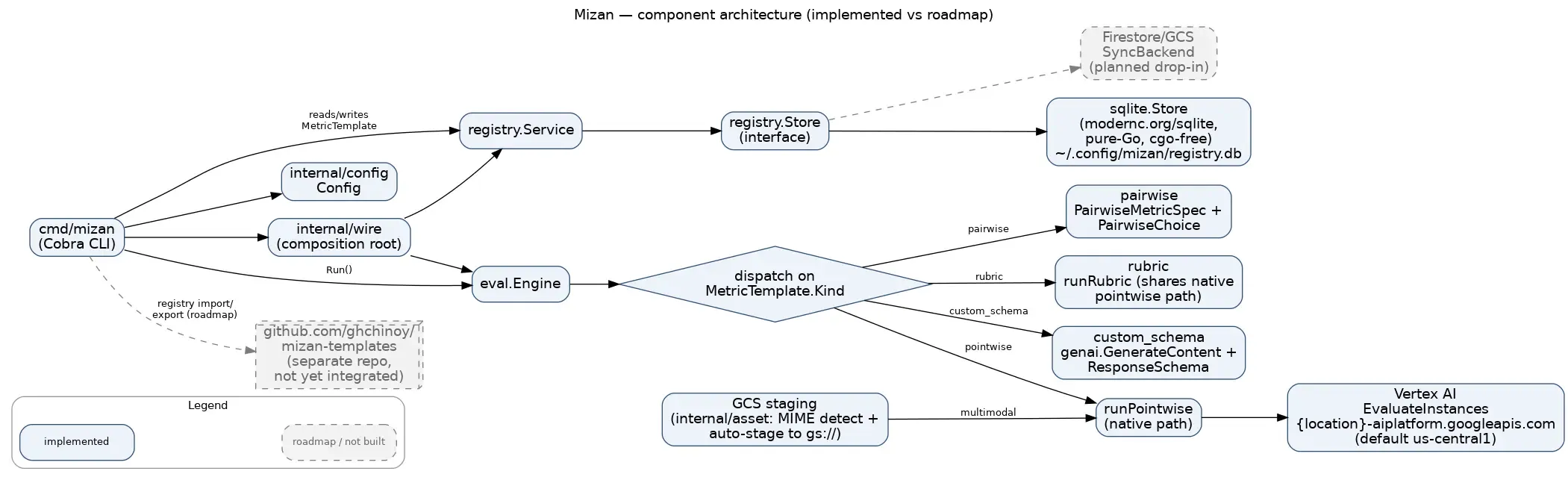
Component diagram (current build vs roadmap). All four metric kinds
(pointwise, rubric, custom_schema, pairwise) and GCS multimodal staging are
implemented and CLI-runnable end-to-end, so those nodes/edges are solid. Only
two elements remain genuinely dashed/roadmap: the Firestore/GCS SyncBackend
(still a planned drop-in, not built) and the external mizan-templates repo
integration (registry import|export/pack still don’t exist in this binary):
4. Go version
Section titled “4. Go version”- Container ships go1.26.1; the draft referenced 1.25.x (from the
eldamo-appprecedent). - Decision: target the toolchain in the build container —
go 1.26ingo.mod(toolchain go1.26.1). No language feature in this design requires 1.26 specifically, so this is low-risk and reversible; pin to what actually builds here rather than to a precedent repo’s older line. - Wails v2.13.0 is compatible with the go1.26 line for the desktop phase; if
Spike 6 surfaces a Wails/toolchain incompatibility, that is one trigger to
revisit the (currently rejected) go.work split so desktop can pin its own
toolchain— §5. Pending Spike 6 verdict on any Wails-specific pin.
5. Module layout — RESOLVED: single Go module (spike-core Spike 0)
Section titled “5. Module layout — RESOLVED: single Go module (spike-core Spike 0)”Verdict (spike-core, 2026-08-09): a single Go module, not go.work. A
buildable scaffold was pushed to branch spike/scaffold on ghchinoy/mizan
confirming it. Rationale from the spike: the single module is simplest, matches
the eldamo-app precedent, and the anticipated Wails transitive-dep bloat did not
justify the two-module ceremony at this stage.
- Chosen — single module. One
go.mod,cmd/mizanandcmd/mizan-desktopunder one module. P1 builds against it directly. - Rejected —
go.worktwo modules (mizan-core+mizan-desktop). Would keep CLI-onlygo installleaner and let desktop pin its own toolchain, but adds a secondgo.modand release/CI ceremony the spike judged premature. Kept as a reversible future option: if the Wails deps later bloatgo install .../cmd/mizan(which the rev-3 templates CI now runs — collaboration-design §3.7), the split can be introduced at the P4 boundary without touching P1.
Rev-3 interaction: the templates CI go installs cmd/mizan (collaboration-
design §3.7). Under a single module that pulls the full dependency set; this makes
the pure-Go SQLite driver recommendation (§8) more pressing (cgo-free
install), and is a data point to watch for a possible later split if Wails deps
land in the CLI’s module graph.
6. Domain model & engine
Section titled “6. Domain model & engine”The authoritative MetricTemplate struct is in collaboration-design.md §6
(it extends the retired draft’s §3 domain struct with Inputs, attribution, and
provenance/sync fields). The engine and eval-time proto materialization are folded
from the retired draft; the eval-layer types are given below and the authoritative
dispatch is the bullets that follow. (CLI surface and desktop bindings folded from
the retired draft are in §12 and §13.)
pointwise/pairwise, text-only →*MetricSpec+JsonInstance.pointwise/pairwise, any non-text asset →*MetricSpec+ContentMapInstancewithFileData(gs://) only — see the inline-bytes finding below.rubric→ shares the nativePointwiseMetricSpec/EvaluateInstancespath withpointwise(runRubricininternal/eval/native.go), because the synchronousEvaluateInstancesAPI has noLLMBasedMetricSpecinput for inline rubric groups (that message exists only on the batchEvaluateDatasetpath, and there it references rubric groups by key, not inline) — instead the rubric criteria are rendered as additional judge-prompt text viarenderRubricGroupsand appended to the metric prompt.custom_schema→genai.GenerateContentwithResponseSchema+ backoff retry.
AutoraterConfig (SamplingCount, FlipEnabled, AutoraterModel) is populated from
the template’s autorater.* fields.
The eval-layer types (folded from the retired draft §3):
type Instance struct {    // Named placeholders -> content. For text, a plain string is enough;    // for other modalities, a reference to an asset (path or gs:// URI).    Fields map[string]AssetRef}type AssetRef struct {    Modality Modality    Text     string // for ModalityText    FilePath string // local file; staged to gs:// for native eval (inline only on the genai custom-schema path)    GCSUri   string // pre-staged asset    MimeType string // detected or explicit}type Result struct {    Score          *float32    PairwiseChoice string // "" unless pairwise    Explanation    string    RawOutput      []string          // if ReturnRawOutput    CustomOutput   map[string]any    // if KindCustomSchema}
type Engine interface {    Run(ctx context.Context, tmpl registry.MetricTemplate, inst Instance) (Result, error)}
Spike 1–3 verdicts — RESOLVED (spike-core, 2026-08-09):
- Placeholder syntax: the API accepts both
{{x}}and{x}; Mizan standardizes on double-brace{{x}}(validator enforces — collaboration-design §3.2/§3.5).- Eval-service region: the native
EvaluateInstancespath targets a specific regional endpoint —us-central1(verified default), plusus-east4,us-west1,europe-west1,europe-west4, andglobalall return live scores;asia-northeast1is rejected (FailedPrecondition) and theusmulti-region endpoint 404s — do NOT use it. DefaultLocation = us-central1(§7). Surface the service’sUnsupported regionerror verbatim. Prefer a concrete region for the native path; reserveglobalfor the genai path below.- The
genaicustom-schema fallback path useslocation=globaland is distinct from the native regional path — keep the two clients/locations separate (this mirrors the inline-bytes asymmetry).- MAJOR — inline bytes are NOT supported by native
EvaluateInstances/ContentMapInstance. All non-text native eval requiresgs://FileDatastaging — GCS staging is mandatory for every multimodal native eval, not just large payloads. There is no inline-Blobfast path on the native route;content.gotherefore emitsFileDataonly for non-text assets and must stage local files to GCS first (or error clearly if no bucket is configured).- Exception — the
genaicustom-schema fallback path DID accept inline bytes. The two paths differ: nativeEvaluateInstances=gs://only;genai.GenerateContent(custom_schema) = inline bytes OK.content.gomust keep the two converters distinct and honor this asymmetry.- Autorater model must be a FULL RESOURCE NAME —
projects/{ProjectID}/locations/{Location}/publishers/google/models/{model}; a bare id (gemini-2.5-pro) is rejectedInvalidArgument: Invalid autorater model resource name. Packs store only a publisher-relative id (portability — they must not embed a project);native.goexpands it to the full resource name at materialization using configProjectID/Location. See collaboration-design §3.2/§6.- Mismatched MIME silently drops the asset —
asset/mime.gomust detect and set the correct MIME or the eval silently loses the input.PairwiseChoiceconfirmed live:BASELINE=1,CANDIDATE=2,TIE=3.These affect
content.go/native.go/asset/and the config defaultLocation, and make GCS staging a P1 prerequisite (implementation-plan § P1). They do not change the module layout or the domain model.
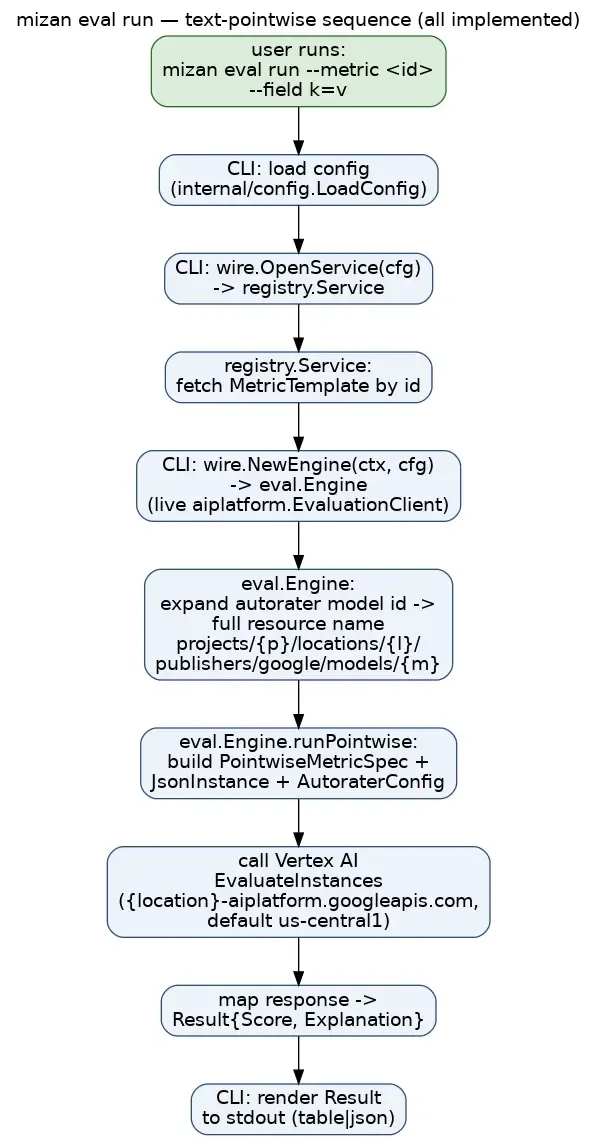
Sequence diagram — text-pointwise eval run (fully implemented). This is
one example of a fully implemented path; rubric, custom_schema, pairwise, and
multimodal are also implemented end-to-end — see the component diagram above:
7. Config
Section titled “7. Config”Per the mcp-common shape (folded from the retired draft), with the collaboration additions:
type Config struct { ProjectID string // required (env PROJECT_ID / MIZAN_PROJECT_ID); default ghchinoy-genai-sa in examples Location string // native eval-service region; default "us-central1" (spike-core). Valid: us-central1|us-east4|us-west1|europe-west1|europe-west4|global. NOTE: the "us" MULTI-REGION 404s (do not use); asia-northeast1 rejected. genai custom-schema path uses location=global separately. StagingBucket string // gs:// staging bucket — REQUIRED for multimodal native eval (inline bytes unsupported, §6); gs:// stripped APIEndpoint string // optional override RegistryDBPath string // default ~/.config/mizan/registry.db (os.UserConfigDir) PackCacheDir string // default ~/.cache/mizan/packs (for `import <git-url>`) DefaultTemplatesRepo string // default "github.com/ghchinoy/mizan-templates" (rev 3) — bare `registry import` source}
StagingBucketis no longer optional for multimodal. Per spike-core, nativeEvaluateInstancesrejects inline bytes, so any non-text native eval needs ags://staging bucket. See §6 and the P1-prerequisite note in implementation-plan.md. Text-only eval and thegenaicustom-schema path do not require it.
8. Dependencies (reconciled go.mod)
Section titled “8. Dependencies (reconciled go.mod)”require ( cloud.google.com/go/aiplatform v1.121.0 // apiv1beta1 only google.golang.org/genai v1.65.0 // custom_schema fallback github.com/spf13/cobra v1.10.2 github.com/mattn/go-sqlite3 <pin> // matches eldamo-app github.com/joho/godotenv <pin> gopkg.in/yaml.v3 <pin> // YAMLCodec (collaboration layer) github.com/Masterminds/semver/v3 <pin> // template version comparison github.com/santhosh-tekuri/jsonschema/v6 <pin> // structural pack validation // desktop module only (see §5): github.com/wailsapp/wails/v2 v2.13.0)SQLite driver — recommendation firmed to pure-Go modernc.org/sqlite (rev 3).
The rev-3 templates CI go installs cmd/mizan to obtain the validator
(collaboration-design §3.7); with the cgo mattn/go-sqlite3 driver that CI would
need a C toolchain. Adopting the pure-Go modernc.org/sqlite driver (drop-in
database/sql) keeps go install .../cmd/mizan@<ver> cgo-free in a stock
setup-go runner — for the templates CI and for end users installing the CLI.
Spike 5 validated the storage layer against mattn/go-sqlite3, but the interface
and JSON-column approach are driver-agnostic, so swapping the driver is low-risk.
Confirmed in P1 (WI-P1-1): go.mod pins modernc.org/sqlite v1.56.0; the
mattn/go-sqlite3 line in the dependency block above is superseded and kept
only as the historical rationale for why the pure-Go driver was chosen.
9. Alternatives Considered (architecture level)
Section titled “9. Alternatives Considered (architecture level)”- Two independent apps (no shared core) — rejected; duplicates domain/eval
logic, guarantees drift between CLI and GUI. Shared
internal/is the whole point of the layout. - GA
apiv1— rejected (research.md §2: no multimodal/autorater/batch). - Silent genai fallback for all custom output — rejected;
custom_schemais an explicit, declared metric kind so behavior is predictable and testable (research.md §3). - Firestore as the primary/only Store from day one — rejected (user deferral; adds infra + auth + offline handling before any value ships). The seam preserves the option.
10. Open Questions (architecture level)
Section titled “10. Open Questions (architecture level)”- Module layout — RESOLVED (spike-core Spike 0): single Go module. §5.
- SQLite driver — RESOLVED (confirmed in P1, WI-P1-1): pure-Go
modernc.org/sqlite(cgo-freego installfor the rev-3 templates CI and end users; seego.mod). §8. - Eval-service region / placeholder syntax / inline bytes — RESOLVED
(spike-core): default
us-central1; double-brace{{x}}; inline bytes unsupported on native eval → GCS staging mandatory for multimodal. §6/§7. apiv1beta1preview stability posture for a production tool (research.md §7 open item) — confirm breaking-change cadence before GA claims.- Pack repo location — RESOLVED (user, 2026-08-09, rev 3): dedicated
github.com/ghchinoy/mizan-templatesrepo (supersedes rev-2 in-repo). See collaboration-design.md §3.3/§3.7. - GCS staging provisioning (NEW, spike-core): the eval SA
sa-scion-warmuplacksstorage.buckets.create/list; a staging bucket must be provisioned (or the SA grantedstorage.admin) before P1 multimodal eval works. Hard dependency — see implementation-plan.md P1 prerequisites. Raise to user/owner. - Validator provisioning for the templates CI (rev-3): no tagged
mizanrelease exists to pinMIZAN_VERSION; needs a release/tag workflow or amainpseudo-version, plus aMIZAN_RO_TOKENsecret. collaboration-design §3.7/§7.
11. Acceptance Criteria (architecture level)
Section titled “11. Acceptance Criteria (architecture level)”go build ./...succeeds on go1.26.1 as a single module (§5);go vetclean. Nopacks/tree or pack CI exists in this repo (rev 3) — they live inmizan-templates.- Dependency-direction check passes:
cmd/*imports onlyregistry.Service,eval.Engine,config— neversqlite/sync/codec/aiplatformpb. evalunit tests pass against a mockedEvaluationClient; integration tests compile behind//go:build integration.go install github.com/ghchinoy/mizan/cmd/mizan@<ver>succeeds cgo-free in a stocksetup-gorunner (pure-Go SQLite driver, §8) — the rev-3 templates-CI requirement.- Remaining pending spike verdicts (§10 Q4) are resolved and recorded in docs/research.md §7 before the packages they gate are implemented; the spike-core verdicts (§5/§6/§7/§8) are already folded in here.
12. CLI surface (Cobra)
Section titled “12. CLI surface (Cobra)”Folded from the retired draft §6 and reconciled to the rev-3 command set (§3).
This block is kept as historical/design-level and is not updated
flag-by-flag as the CLI evolved (for example, the shipped flags are --prompt
and --flip-enabled, not --prompt-template/--flip as sketched below). For
the real, current, live-verified CLI surface, see
docs/testing-guide.md and
docs/user-guide.md.
# Registry — local working-copy CRUDmizan registry create --name <n> --kind pointwise --modality text \    --prompt-template ./template.txt [--modality image ...]mizan registry listmizan registry get <name>mizan registry update <name> [--prompt-template ./template.txt] [...]mizan registry delete <name>
# Registry — share (contribution layer; see collaboration-design.md §3.6)mizan registry import <src> [--strategy newer|skip|overwrite|fork] \    [--namespace <ns>] [--dry-run]   # src = git URL | pack dir; bare src = default templates repomizan registry export <name> --out <dir>          # write template(s) as an on-disk pack
# Packs — author/scaffold and validate locallymizan pack init <dir>                             # scaffold a new pack (manifest + skeleton)mizan pack validate <dir>                         # structural + lint validationmizan pack add <dir> <name>                       # add a template to a pack
# Evalmizan eval run --metric <name> \    --field response=./output.mp4 \    --field prompt="a dog running in a park" \    [--sampling-count 4] [--flip] [--output json|table]mizan eval pairwise --metric <name> \    --candidate ./a.mp3 --baseline ./b.mp3 --field context="..."
# Configmizan config showmizan config set project-id ...
Follows the drivectl precedent: cobra.Command.GroupID groups the registry,
pack, eval, and config subcommand families. Per the dependency direction in
§3, cmd/mizan imports only registry.Service, eval.Engine, and config —
never sqlite/sync/codec/aiplatformpb.
13. Wails desktop bindings (Phase 4)
Section titled “13. Wails desktop bindings (Phase 4)”Folded from the retired draft §7. Phase 4 — not the MVP. internal/app/app.go
binds a thin layer that wraps registry.Service and eval.Engine (the rev-3 seam,
§3); it holds no domain logic of its own:
func (a *App) ListMetricTemplates() ([]registry.MetricTemplate, error)func (a *App) SaveMetricTemplate(t registry.MetricTemplate) errorfunc (a *App) DeleteMetricTemplate(id string) errorfunc (a *App) RunEvaluation(metricID string, fields map[string]string) (eval.Result, error)func (a *App) PickFile() (string, error) // wraps wails runtime.OpenFileDialogfunc (a *App) GetConfig() (config.Config, error)func (a *App) SaveConfig(c config.Config) errorFrontend stack: Lit + Vite, matching the eldamo-app precedent (avoids
introducing React/Vue tooling churn); wails.json adapted from eldamo-app with
name/paths adjusted. The Go and Wails toolchain versions are governed by §4 and §5
and are deliberately not restated here to avoid drift.