
homectl System Architecture
homectl is structured as a modular smart home control platform. It decouples device-level protocols from user-facing applications (CLI, TUI, and Web UI) while providing standalone Agent Plugins and Model Context Protocol (MCP) servers for autonomous AI agents.
High-Level Architecture Diagram
Section titled “High-Level Architecture Diagram”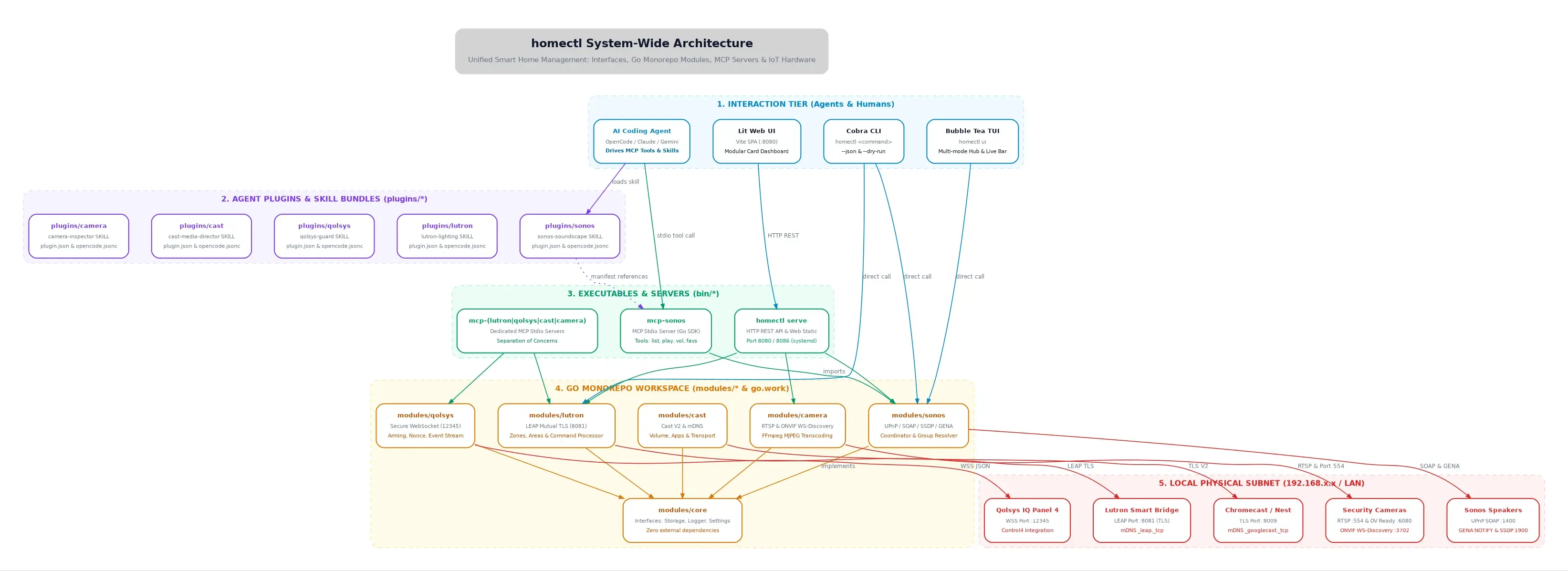
Architectural Tiers
Section titled “Architectural Tiers”1. Interaction Tier (Humans & AI Agents)
Section titled “1. Interaction Tier (Humans & AI Agents)”- AI Coding Agents (OpenCode, Claude, Gemini): Interact with
homectlvia Model Context Protocol (MCP) tool calls over standard I/O (stdio). Agent reasoning is guided by declarative Agent Skills (skills/<name>/SKILL.md) that codify safety rules, token economics, and error recovery protocols. - Cobra CLI (
cmd/): Scriptable command-line interface supporting human-friendly tabular output and machine-readable structured output via the--jsonflag. All mutating commands support--dry-runsimulation. - Bubble Tea TUI (
pkg/tui): Responsive terminal dashboard featuring multi-mode tab navigation (Lights, Music, Areas), live volume and dimming progress bars, and inline nickname editing. - Lit Web UI (
ui/): Fast, reactive single-page application built with Lit WebComponents and Vite. Utilizes an isolated “smart parent / dumb card” component architecture with optimistic state updates.
2. Agent Plugin Tier (plugins/<svc>/)
Section titled “2. Agent Plugin Tier (plugins/<svc>/)”Each integrated IoT ecosystem is packaged as a self-contained Agent Plugin adhering to the Agent Plugins Specification 1.0.0:
plugin.json: Plugin metadata, semantic version, and author declaration.mcp.json: Standard MCP server registration defining stdio execution (mcp-<svc>).opencode.jsonc: Native OpenCode configuration format mapping local binary paths.skills/<name>/SKILL.md: Canonical skill rules synchronized automatically from top-levelskills/viamake sync-skills.
3. Service Gateway & MCP Servers (bin/*)
Section titled “3. Service Gateway & MCP Servers (bin/*)”homectl serve: HTTP API server running on port8080(or8086undersystemd), providing REST endpoints (/api/lutron/*,/api/sonos/*,/api/cast/*,/api/security/*) and hosting compiled Web UI assets.- Standalone MCP Servers (
cmd/mcp-<svc>/): Dedicated micro-executables (mcp-sonos,mcp-lutron, etc.) built with@modelcontextprotocol/go-sdk. Each server enforces strict separation of concerns, ensuring an agent only loads the tools relevant to its current domain.
4. Disaggregated Go Monorepo (modules/*)
Section titled “4. Disaggregated Go Monorepo (modules/*)”The Go codebase is organized as a multi-module workspace (go.work):
modules/core: Interface-only foundational module defining injectable primitives:core.Storage: Abstract filesystem operations (XDG standard vs. in-memory for testing).core.Logger: Pluggable structured and standard loggers without globalinit()side-effects.core.Settings: Configuration parameters (e.g.CallbackIPfor inbound NAT traversal).
- Per-Service Domain Modules (
modules/sonos,modules/lutron, etc.): Encapsulate protocol clients, state management, and network calls. Each module contains its own isolatedgo.modand comprehensive mock-transport test suites.
5. Local Physical Subnet Tier
Section titled “5. Local Physical Subnet Tier”homectl interacts directly with hardware on the local network (192.168.x.x):
- Lutron Smart Bridge Pro: Mutual TLS connection on port
8081using the LEAP protocol. - Sonos Whole-Home Audio: SOAP calls over HTTP port
1400, SSDP multicast discovery on UDP1900, and inbound GENA push notifications. - Google Cast: Encrypted TLS channel on port
8009with mDNS discovery (_googlecast._tcp). - Security Cameras: RTSP H.264 video streaming on port
554, Omnivision control on port6080, and ONVIF WS-Discovery on UDP3702. - Qolsys IQ Panel 4: Encrypted WebSocket stream on port
12345(wss://).
State & Privacy Isolation
Section titled “State & Privacy Isolation”- Runtime State (
~/.config/homectl/): Adheres to the XDG Base Directory specification. Stores user settings (config.json), device nicknames (nicknames.json), and discovery caches (lutron_cache.json,sonos_cache.json). - Private State (
local/): The repository includes a strictly gitignoredlocal/directory (local/NETWORK_DISCOVERY.md, local TLS certificates) ensuring real physical MAC addresses, static IPs, and residential layouts are never committed or published to public repositories.